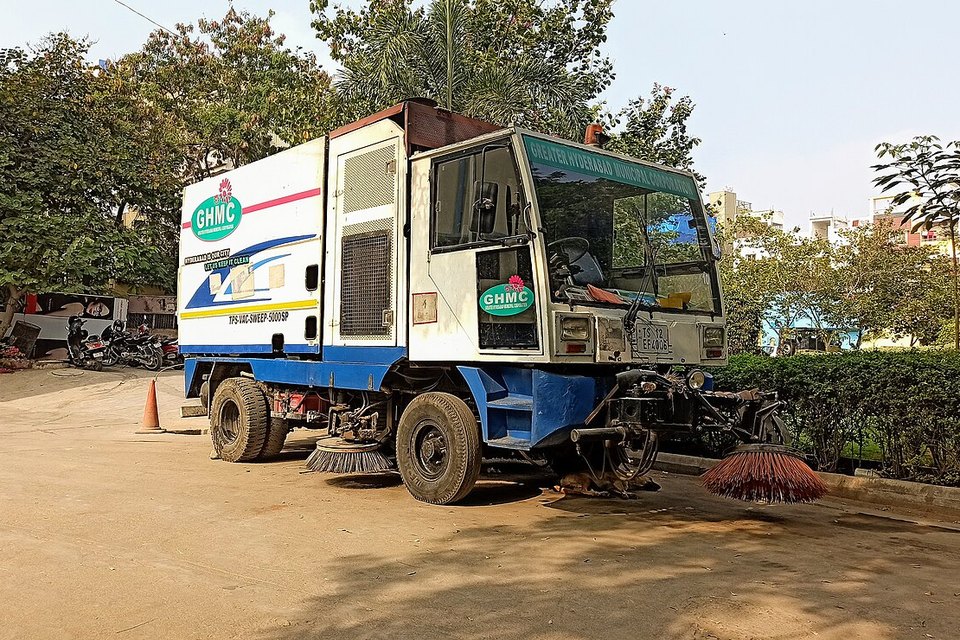
Delhi's civic body currently operates 66 mechanical road sweepers, deployed across roughly 1,400 km of arterial roads wider than 60 feet, and says the existing fleet lifts about 190 tonnes of road dust a day. The performance of that fleet has been questioned repeatedly by councillors and resident groups. The 70 incoming units are self-propelled machines imported from European suppliers, with sweeping capacities of 2 cubic metres and 4 cubic metres and an additional third front brush intended to improve the removal of dust and road debris. A field trial of one of the airlifted units was held outside the Civic Centre on 1 October 2026, with funding support from the Delhi government's Department of Environment.
Road dust is the reason the machines matter. A 2018 source-apportionment study by The Energy and Resources Institute (TERI) estimated that dust could account for up to 25 per cent of Delhi's air pollution, and identified potholes, unpaved roads and broken footpaths as major contributors. PM10 — the coarse fraction that mechanical sweeping is designed to capture — is relatively heavy and does not travel as far as finer particulate matter, so local street-cleaning capacity has a direct bearing on measured concentrations. For Delhi, the winter months are when sweeping capacity is under the most pressure.
The 70 machines are being procured and operated under a service-outsourcing model, with the contract already awarded. Delivery scheduling has slipped, however: units have so far been airlifted to Delhi for demonstration and trials only, and officials say every effort is being made to begin full deployment from mid-November 2026. To keep mechanised sweeping capacity available through the winter pollution period in case the awarded machines do not arrive on time, the MCD floated a pan-India tender on 29 September 2026 to hire 40 additional road sweepers on a four-month interim basis.
For equipment suppliers and distributors, Delhi is a useful read on how large Asian cities are specifying street-cleaning fleets. The direction of travel is toward self-propelled units with several cubic metres of hopper capacity, a third front brush for kerb-to-kerb coverage, and a mix of drivetrains — electric for shift-based inner-city work, CNG where refuelling range or duty cycles favour it. The episode also underlines a procurement risk that is easy to overlook: when an entire fleet expansion depends on a single overseas supply route, any transport disruption has to be absorbed by short-term hired capacity, at a cost and at a service level that municipalities are increasingly reluctant to accept.