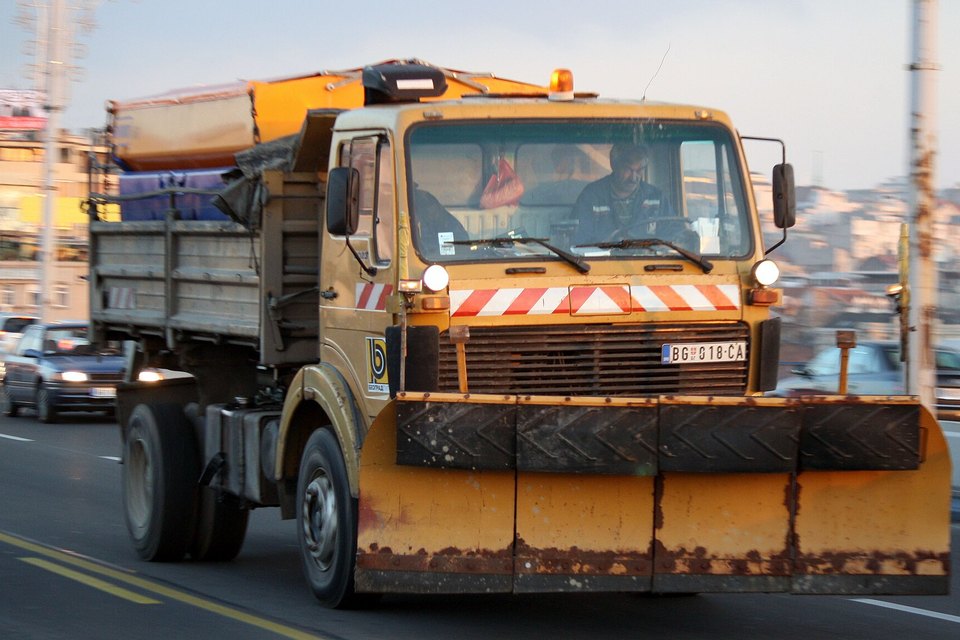
The network is not maintained as one block. Putevi Srbije splits it into three service tiers, and the tiers define what a truck has to be able to do. First priority covers 6,389.101 km, where the carriageway is cleared and treated with pure salt so that traffic keeps moving at a reduced safe speed of up to 60 km/h in snow or ice. Second priority covers 4,368.206 km, cleared and treated only with fine crushed aggregate at up to 80 grams per square metre, holding traffic to 40 km/h. Third priority covers 4,424.490 km, where snow is simply removed to keep the road passable at 40 km/h — and only after the first and second priority roads have been done. Ljerka Ibrović, who heads the company's public relations department, presented the plan; Zoran Stojisavljević, director of the sector for maintenance of first and second order state roads, said the objective is "to respond to situations that may arise during the winter season and to ensure safe and uninterrupted traffic flow", with attention concentrated on salt and aggregate stockpiles, shift scheduling and coordination between the institutions involved.
The equipment count is where the plan gets interesting for anyone who builds bodies and implements. Against 850 road maintenance vehicles and trucks, the plan lists 343 heavy machines — loaders, graders, bulldozers, a special vehicle with a milling cutter and truck cranes — and 1,338 pieces of equipment: ploughs, plus towed and rotary spreaders. In other words, there are roughly 1.6 implements for every prime mover in the fleet, which is what a working winter fleet looks like: the chassis is the long-life asset, the steel that touches salt, grit and asphalt is what gets consumed. The workforce behind it is 2,412 people per shift, broken down into 1,037 road maintenance workers, 183 technicians, 343 machine operators and 849 drivers. Materials held for the season are 95,000 tonnes of salt including reserves, about 100,000 tonnes of crushed stone and aggregate, and roughly 1,000 tonnes of cold-mix asphalt for pothole repairs.
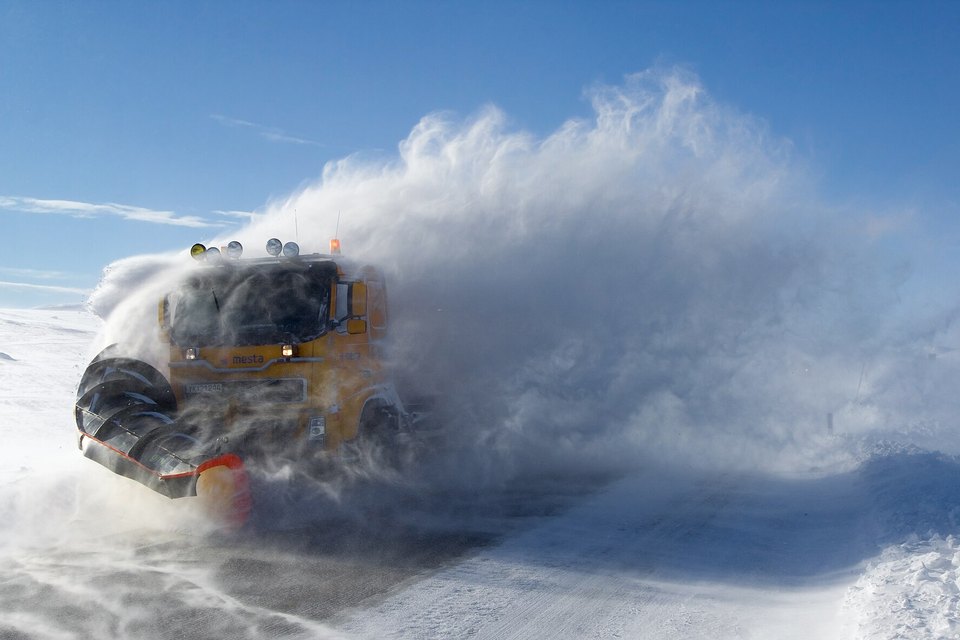
The plan is also unusually decentralised, and that shapes how the fleet is bought. The 175 road bases and points are split into 43 on motorways and expressways and 132 on IB and II order roads, with machinery present around the clock at the motorway bases. Maintenance is carried out by 22 road companies plus two service companies, Srbijaput Belgrade and Vojvodinaput Novi Sad. The winter plan is a binding framework that every maintenance company must translate into its own operational plan, so the buying decision is not made by a single state fleet office but by more than twenty contractors, each sizing equipment to its own stretch of road, its own base and its own shift roster.
The plan names the sections that get special attention, and they read like a specification sheet. The Gazela bridge, the Bubanj Potok and Mečka passes and Begaljičko Brdo on the motorway; the Čestobrodica pass on the Paraćin–Zaječar road at 600 metres; the Rušanj and Rudnik climbs on the Ibar road; the Zlatibor pass at 1,000 metres; the Popadija, Tresibaba and Svetinja passes; the Fruška Gora passes at Iriški Venac and Banstol; the wider Tara, Crna Trava and Sjenica areas; the Beška bridge on the Belgrade–Novi Sad road; the Jaram pass on the Brzeće–Kopaonik road; the Sava bridge on the Dobanovci–Ostružnica bypass; the Prijevorac bridge zone on the reconstructed IB-21 between Borova Glava and Kokin Brod; the Belgrade bypass from Sector 3 to the Bubanj Potok interchange; and the new Batajnica bridge with its ramps. Mountain passes, long grades, bridges that ice first — a mix that pulls in shorter wheelbases and higher traction rather than one standard long-haul tractor.
The first week of the season showed how quickly the plan meets reality. According to Srpske Novine, snow settled on Kopaonik and Golija on the morning of 3 November, and by 05:04 on 4 November the winter service was reporting patches of slushy snow up to five centimetres deep around Ivanjica, wet carriageways on first priority roads at lower altitudes, and second priority roads passable and free of snow. A ban on trucks and vehicles with trailers was in force on the II A-211 Brzeće–Kopaonik road over the Jaram pass. In the east, small rockfalls kept coming down in the Đerdap gorge on the I B-34 road and on the II A-221 stretch between Knjaževac and Kalna. For freight, the cost showed up at the borders: trucks leaving Serbia were waiting about four hours at Šid, three hours at Kelebija and Batrovci, and about one hour at Gradina. Under the Road Traffic Safety Law, winter equipment is mandatory from 1 November to 1 April whenever there is snow, ice or black ice on the carriageway.
The plan is backed by services that sit outside the road companies. Assistant chief of the fire and rescue units administration Milorad Spasojević said the emergency sector has 3,873 firefighters and rescuers in 163 operational units, supported by about 356 fire vehicles and six snowmobiles. Slobodan Sovilj, head of the national centre for hydrometeorological early warning at RHMZ, said a warmer and wetter winter is expected, but warned that short incursions of cold air, heavy snowfall, severe frost and icy roads remain possible — the scenario the fleet is stocked for. The Auto-Moto Association of Serbia (AMSS) keeps its operations centre open 24 hours a day, with roadside assistance on 1987, and the traffic police will again check winter equipment and vehicle roadworthiness, according to Colonel Vladan Nikolić, assistant chief of the traffic police administration.
Read together, the numbers describe a market rather than an event. A season that is fixed at five months, a network split into tiers with different treatment standards, 175 bases that each need a small, self-sufficient set of vehicles and implements, and a buyer list of more than twenty road companies and two service companies — that is a procurement structure in which chassis supply, body mounting and consumable spares are three separate conversations. It is also a calendar: equipment has to be in base before 1 November, which puts the ordering window in the late summer, with a second, smaller wave of retrofit and replacement work once the first snow exposes what is missing.